F*ck that home of the free krap. Amerika, is now home of the worlds largest police state. And our elected officials are just as evil as the dictators of Third World countries.
Sadly the "War on Drugs" has turned America into the worlds largest police state.
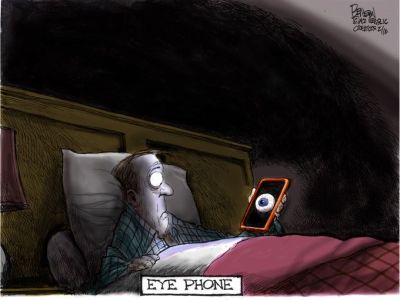
This editorial says the FBI goons are violating Apple's 1st Amendment rights by demanding that Apple write software to help the FBI unlock an iPhone.
I suspect it would also be a violation of Apple's 13th Amendment rights. The 13th Amendment forbids slavery, except when a person is convicted of a crime by the government.
Justice Dept. questions Apple's motives in refusing to help FBI
Brian BennettBrian BennettContact Reporter
The battle over Apple's refusal to give the FBI the tools to unlock a terrorist's smartphone escalated sharply Friday when the government urged a federal judge to immediately compel the tech giant to comply, arguing that it appears more concerned with marketing strategy than national security.
In a 35-page filing aimed at public opinion as much as the judge, Justice Department lawyers questioned Apple's motivation for defying U.S. Magistrate Judge Sheri Pym's order this week to help the FBI open Syed Rizwan Farook's encrypted iPhone 5c.
The government argued Friday that Apple Chief Executive Tim Cook's public Feb. 16 letter declaring, "We oppose this order," should be taken as the company's response.
Apple's refusal, they wrote, "appears to be based on its concern for its business model and public brand marketing strategy," not a legal rationale.
Apple technicians told investigators they could write the software the FBI wants to unlock Farook's phone, and technology providers previously have written code to comply with subpoenas and court orders, according to the filing.
"Apple rejected the government's request, although it conceded that it had the technical ability to help," the filing states. It also says Apple's public statements have been misleading.
Pym gave Apple until next Friday to respond, and set a hearing for March 22 in U.S. District Court for Central District of California in Riverside.
In a conference call with reporters, senior Apple executives, speaking on condition that they not be identified or quoted, said the government's motion was designed to get media attention. They described the FBI's request as overreaching by the government.
The executives denied that the decision to fight Pym's order was about marketing, insisting they are acting to protect customers' privacy. Complying, they said, would create a back door to breach the iPhone's security features.
It's unclear what help, if any, the contents of Farook's phone might provide investigators. Nearly seven weeks of potential messages, texts, photos and data are missing — from Oct. 19, when Farook last uploaded his phone to iCloud, to Dec. 2, when he carried out a shooting rampage at the Inland Regional Center in San Bernardino. Apple-FBI battle over San Bernardino terror attack investigation: All the details Apple-FBI battle over San Bernardino terror attack investigation: All the details
No evidence has surfaced so far to indicate Farook and his wife, Tashfeen Malik, were in contact with terrorists, or had received outside support, before the attack, which left 14 people dead. The couple were later killed in a shootout with police.
Apple and its supporters say the dispute isn't over the unknown contents of one phone, but about the government trying to establish a precedent that it can force a company to hack its customers' devices.
That could open floodgates for requests from local, state and federal prosecutors, they warn, and cripple customers' confidence in Apple products, especially in lucrative overseas markets where distrust of government surveillance is higher.
Apple's advocates fear that giving in to the FBI now ultimately would help criminal hackers and authoritarian governments, which might use the software to trace secret communications of political opponents and human rights activists.
The issue inevitably landed in the presidential race, as GOP candidate Donald Trump said Americans should not buy Apple products until the company agrees to help the FBI unlock Farook's phone.
"What I think you ought to do is boycott Apple until such time as they give that security number," he said Friday. See the most-read stories this hour >>
More broadly, the escalating dispute with Silicon Valley reflects the government's struggle to keep up with the challenge of obtaining evidence from encrypted cellphones and apps.
Both have grown far more popular since the 2013 disclosures of widespread government surveillance by former National Security Agency contractor Edward Snowden.
Apple began encrypting new cellphones by default in September 2014.
The case also revealed a rift inside the Obama administration over how to balance privacy and national security when it comes to high tech.
For more than a year, in meetings in the Situation Room in the basement of the West Wing, FBI Director James B. Comey pleaded with White House officials to pressure Silicon Valley to do more to help investigators decode encrypted messages in criminal and terrorism cases.
The response: more closed-door meetings with Apple, Google and other high tech companies, but little apparent progress.
Comey's frustration was clear when the Justice Department decided on its own to go to court in the San Bernardino case.
"What you are seeing here is a unilateral act to get done what they think they need to get done," said an administration official who spoke on condition of anonymity to describe the deliberations. "It is a milestone moment. It is a break from the dialogue and the desire to keep it friendly."
On one side of the debate inside the administration were White House advisors who favored using quiet pressure to persuade Cook and other tech executives to cooperate.
That approach has borne fruit, they say. Over the last year, tech companies have shut down social media accounts used by Islamic State, handed over subpoenaed material that suspects had loaded on "cloud" servers, and given other crucial help.
But members of President Obama's national security team wanted more.
What is being asked to be done here on the scale of things is pretty invasive. - Ryan Calo, assistant law professor at the University of Washington in Seattle
Together with state and federal prosecutors around the country, they viewed tech companies as making money while protecting terrorists, kidnappers, pornographers and others who use encryption to hide illegal schemes.
Comey warned the Senate Judiciary Committee last fall that the FBI was in danger of "going dark," noting that investigators could not read 109 encrypted messages that a gunman had sent to an "overseas terrorist" hours before he tried to attack a prophet Muhammad cartoon contest in Garland, Texas, last May.
On Jan. 8, top tech executives heard pleas for help on encryption during a meeting in San Jose attended by White House Chief of Staff Denis McDonough, Atty. Gen. Loretta Lynch, Director of National Intelligence James Clapper and Comey.
When Apple and its allies refused to budge, Comey hinted at a congressional hearing that the FBI's patience had frayed.
"We still have one of [the San Bernardino] killer's phones that we have not been able to open," he told the Senate Intelligence Committee last week. "It's been over two months now, and we're still working on it."
The new details were intended to warn Apple that the FBI might go further if Apple didn't give more help in the case.
"I would like people to comply with court orders, and that's the conversation we're trying to have," he said.
Other critics soon chimed in.
In New York, the Manhattan district attorney's office said its investigators are locked out of more than 175 Apple devices that could provide crucial evidence in criminal cases.
"The problem is getting worse over time," said Joan Vollero, spokeswoman for Cyrus R. Vance Jr., the district attorney.
After the San Bernardino shooting, Apple provided the FBI with data from Farook's work iPhone that he had backed up remotely. But he did not save to iCloud for weeks before the shooting, and investigators believed he may have sought to hide location data, photos or messages.
For weeks, Apple technicians worked with the FBI's Orange County Regional Computer Forensics Laboratory to explain the password protection on the phone, and the feature that would automatically erase its memory after 10 incorrect password attempts.
Apple recommended trying to back up to Farook's iCloud account over the Internet, but investigators could not. Shortly after the attack, a San Bernardino County employee apparently had reset the password remotely. That made it impossible to initiate the auto-backup feature later, according to a footnote in Friday's filing.
With that pathway closed, FBI officials concluded Apple could write software to disable the auto-erase setting, and make it possible to try password combinations until the phone opened. Apple refused.
In January, federal prosecutors drafted a motion to compel Apple to act but held back on filing it in court, hoping Apple would comply. They also feared making the request public would alert would-be criminals to the FBI's limitations and the phone's encryption.
The court filing Friday made clear prosecutors have overridden those concerns — even if their legal argument remains untested.
"In the court of public opinion, a dead terrorist whose phone might have connections to more terrorists is pretty attractive from the standpoint of prosecution, but the legal question is not made easier because of that," Ryan Calo, an assistant law professor at the University of Washington in Seattle and an expert on privacy law, said in a phone interview.
No court has ruled on whether a tech company could be forced to find a way around its own security features, Calo said.
"What is being asked to be done here on the scale of things is pretty invasive," Calo said.
"They are asking for a lot, not a little."
brian.bennett@latimes.com
Times staff writers Paresh Dave and Maura Dolan in Los Angeles contributed to this report.
F*ck the DOJ!!! This is just a stunt or really a political more to flush the Bill of Rights down the toilet.
My opinion that that DOJ and FBI are trying to violate Apples 1st and 13th Amendment rights.
The 13th Amendments says slavery is illegal unless a person has been convicted of a crime. And in this case the DOJ and FBI want to make Apple it's slave and have Apple write software to allow the DOJ and FBI to see what's on the iPhone.
F*ck the DOJ! F*ck the FBI. They are both the PROBLEM, not the solution to the problem.
Feds Say Apple's Stand Against the FBI Is Just a PR Stunt
Kate Knibbs
Feds Say Apple's Stand Against the FBI Is Just a PR Stunt
The Department of Justice has filed for a court order to compel Apple to assist it in unlocking the phone that belonged to one of the dead San Bernardino shooters. “Apple is not above the law,” it reads.
If this sounds familiar, that’s because there is already a court order covering the exact same case, which was handed down earlier this week. Tim Cook publicly challenged the order, which has galvanized a discussion on security and tech companies’ cooperation with law enforcement.
Today’s motion is for a court order to compel Apply to comply with the initial court order. (Ahhh, the legal process.) The distinction with the old order is that the new one is way surlier. “Apple’s current refusal to comply with the Court’s Order, despite the technical feasibility of doing so, instead appears to be based on concern for its business model and brand marketing strategy,” it reads. In other words: This is just good PR.
Apple’s legal response to the initial court order is due February 26, and the government is due to respond March 5—after which Apple will have up until March 15 to respond with a brief.
The DOJ doesn’t want to wait that long, and views Tim Cook’s public response as the equivalent to the response the company would give in court. In this new motion, the DOJ stresses the urgency of the investigation:
Apple’s public statement makes clear that Apple will not comply with the Court’s Order. The government does not deny Apple its right to be heard, and expects these issues to be fully briefed before the Court; however, the urgency of this investigation requires this motion now that Apple has made its intentions not to comply patently clear.
In case there was any ambiguity about whether the DOJ thinks Apple is being irresponsible, the motion essentially states that Apple designed a phone to mess up law enforcement. “Apple designed its software and that design interferes with the execution of search warrants,” the motion reads.
The DOJ also stresses that it didn’t necessarily need to file a second order:
While it is obviously true that Tim Cook’s statement against complying with the is excellent PR for Apple, this does not make the position wrong. At any rate, the lesson today, in case there was any question at all, is that the DOJ means business.
If you ask me the Feds are trying to screw both Apple and the Bill of Rights.
Requiring Apple to write software so the FBI goons can break into an iPhone also sounds like a violation of the 13th Amendment which forbids slavery (except when a person is convicted of a crime).
This is why many people hate the police and government. These government *ssholes think they are above the Constitution because they have guns and shiny tin badges.
Robb: Apple is right about terrorist's iPhone
Robert Robb, The Republic | azcentral.com 4:42 p.m. MST February 19, 2016
The government cannot require Apple to create something
The implication of what the federal government is demanding that Apple do regarding the smart phone of the San Bernardino terrorist is not being fully understood or properly framed.
The government isn’t demanding relevant information or material that Apple possesses. Such demands, backed by court orders if necessary, are ordinary and appropriate in criminal investigations. Apple has already provided the government what it has that fits the usual kind of document demands, including information the terrorist had stored in Apple’s cloud service.
However, the terrorist quit backing up his phone on the cloud several weeks before the attack. The FBI can’t figure out how to bypass the security features on the phone. Apple currently has no way of doing it either.
So, the government sought, and received, a court order requiring Apple to create software that could be loaded onto the phone that would enable the FBI to circumvent the security protections and access the phone’s content. Such software doesn’t currently exist.
Apple has vowed to fight the order, saying that the government is basically ordering it to develop a backdoor to its phones that would compromise the security of the data of all its customers.
Apple can't turn over something that doesn't exist
That, however, isn’t the real point. The government, in the course of a criminal investigation or intelligence gathering related to terrorism, can’t conscript private parties into its service. The government can require Apple to turn over anything relevant it possesses. It has no authority, in the course of an investigation, to require Apple to create something that doesn’t exist. And neither does a judge. That’s contrary to our system of law.
The question of whether there should be a general statute, enacted by Congress, requiring phone manufacturers to include a backdoor that would enable law enforcement in the course of an investigation to override security features is a different matter entirely. The manufacturers claim that would open up their phones to criminal hackers. Law enforcement officials assert differently.
I’m inclined to believe the manufacturers on such a technology question. Regardless, a general law hasn’t been passed by Congress. And until it is, the government shouldn’t be able to conscript Apple to create backdoor software that doesn’t currently exist through a court order in an individual criminal investigation, regardless of how important and high profile.
Reach Robb at robert.robb@arizonarepublic.com.
Why Apple's fight with the FBI could have reverberations in China
David Pierson David Pierson Contact Reporter
It’s a battle that on its face appears to pit one of the biggest tech companies in the U.S. against the country’s most powerful law enforcement agency.
But the outcome of Apple’s standoff with the federal government over encryption could reverberate across the world, giving authoritarian governments reason to expand surveillance and challenging the U.S. tech industry’s ability to compete globally, technology experts and lawmakers say.
Apple is resisting a federal judge’s order that it build special software to unlock an iPhone used by one of the San Bernardino terrorist attackers.
But if the company is forced to comply, it could bolster recent efforts by countries such as China to curb its citizens’ privacy in the name of national security.
“This completely undermines privacy overseas and if the administration thinks this precedent wouldn’t be used by China, Russia and others then they are in serious error,” said Nicholas Weaver, a senior researcher at the International Computer Science Institute at UC Berkeley.
The White House has told Beijing that it has major concerns about its new counterterrorism law, a somewhat vague piece of legislation that may require American companies to hand over encryption keys and provide backdoor access to their computer systems.
“This is something that I’ve raised directly with President Xi,” President Obama told Reuters last year. “We have made it very clear to them that this is something they are going to have to change if they are to do business with the United States.”
Those demands will be harder to make if the federal government succeeds in getting Apple to give up its fight, according to one of the Senate’s leading voices on technology policy.
“This move by the FBI could snowball around the world,” said Sen. Ron Wyden (D-Ore.), a member of the U.S. Senate Select Committee on Intelligence. “Why in the world would our government want to give repressive regimes in Russia and China a blueprint for forcing American companies to create a back door?”
Doing so, the senator said, wouldn’t just result in further suppression of individuals in those countries, but also a rise in theft of U.S. trade secrets.
“It would be the go-to option for securing information,” Wyden said of a decryption key.
Apple has already reportedly agreed to comply with some Chinese security checks to ensure its devices aren’t accessible to U.S. authorities, but it’s unclear how far that goes.
The company, which did not respond to a request for comment, has been accused by Chinese state media of giving up user data to U.S. intelligence agencies. Chief Executive Tim Cook remains adamant it has never provided a back door for any government agency.
China is particularly treacherous territory for the Cupertino, Calif., company. It’s currently Apple’s second-largest market, responsible for more than a fifth of its revenue, and is expected to grow.
However, it’s complicated by an opaque legal system and a nationalistic sentiment that could turn on foreign companies deemed unsupportive of China’s interests.
Should an iPhone belonging to a suspected terrorist from China’s fractious Xinjiang province require decryption, Beijing, along with popular opinion, wouldn’t afford Apple the ability to argue its case like it’s doing in the U.S.
“Apple has recourse to fight the request through an independent judiciary and Tim Cook feels confident that he can argue publicly against the U.S. government request without fear that Apple's business will be materially damaged by a retributive government,” said Bill Bishop, an entrepreneur and leading China watcher formerly based in Beijing.
Technology companies have long struggled to balance security and privacy with the demands of foreign governments.
Yahoo was admonished by U.S. lawmakers nearly 10 years ago for outing Chinese dissidents through their email accounts.
Microsoft, the target of an anti-monopoly probe in China, recently announced a joint venture with a Chinese firm to supply a customized version of its Windows 10 operating system aimed at tackling rampant piracy of its software there.
BlackBerry continues to negotiate with the government of Pakistan after it rebuffed an order to provide customer emails and chats.
And authorities in Brazil briefly shut down Facebook’s WhatsApp messaging app last December for not cooperating in a criminal investigation. The service was quickly returned after a public outcry.
When it comes to doing business abroad, tech companies are being squeezed on both sides: If they don’t give up access to user data, they risk angering governments. But if they are perceived as selling products that aren’t secure, consumers won’t buy them. And that hurts the all-important bottom line.
Forrester Research estimates American cloud computing firms will lose global sales of up $180 billion by the end of this year because of the chilling effect of Edward Snowden’s National Security Agency leaks in 2013.
If American smartphone brands are thought to be compromised, it wouldn’t just hurt Apple, but also Google (now Alphabet Inc.), whose Android mobile operating system is used on more than 80% of the world’s smartphones, according to Gartner.
“You could see a similar effect here where customers say they don’t want to buy Apple because who knows when they’d be forced to turn over information to the U.S. government,” said Jan Dawson, chief analyst at Jackdaw Research. “The reality is that it will affect all these companies including Apple, Google and Microsoft.”
Chinese companies have also been met with resistance in the U.S. Huawei, one of China’s leading technology and telecommunications firms, has failed to make inroads in America after a congressional committee declared the company a security threat in 2012 because of its ties to the Chinese military.
Weaver, the researcher at UC Berkeley, said if the FBI wins its battle with Apple, the NSA could soon make similar requests through the secretive Foreign Intelligence Surveillance Court.
That would set a precedent for other spy agencies, including those run by U.S. allies such as France and Israel, to place sweeping demands on tech companies to give up customer data.
“This particular request to [decrypt an iPhone] is remarkably reasonable, but the precedent it sets is disastrously bad,” he said.
Follow me on Twitter: @dhpierson
Julie Makinen in The Times’ Beijing bureau contributed to this report.
Maybe, and I said maybe, I can understand them getting them a search warrant to search the phone.
But sticking a gun to Apple's head and forcing them to write software to unlock the phone sounds like a violation of the 13th Amendment which forbids slavery. Maybe a violation of the 4th and 5th Amendments too.
I am sure that if the Founders were alive today, they would consider the current American police state a thousand times worse then King George's petty police state they had to deal with.
No wonder people hate the government.
We should thank Apple for attempting to protect their customer's from the evil spying Federal government.
Apple face uphill battle against law enforcement
Brad Heath, USA TODAY 1:57 a.m. EST February 19, 2016
Should the government be able to open a "back door," to smartphones in the name of national security? Consumers sound off in Venice Beach, California.
The U.S. Justice Department’s demand that Apple help it break into a locked iPhone is the latest in a series of legal disputes with tech companies over users’ privacy that have been going on for more than a decade.
So far, nearly all of those contests ended the same way.
“Historically the judiciary has been very deferential to law enforcement,” University of California, Hastings law professor Ahmed Ghappour said. “And history could be very indicative of how this will play out.”
The latest episode began this week, when a federal magistrate judge in California ordered Apple to help FBI agents break into the locked iPhone used by one of the gunmen in the December massacre in San Bernardino, Syed Rizwan Farook. Apple CEO Tim Cook said the company would fight the order, and Apple has refused to help unlock at least one other locked phone in the past.
For tech companies, such battles have often not gone well.
In 2007, for example, tech giant Yahoo balked at a secret order from the Foreign Intelligence Surveillance Court requiring it to turn over customer records to the National Security Agency. But the company relented when a judge on the surveillance court threatened to impose a fine of $250,000 a day – and double it every week. A federal appeals court upheld the surveillance court’s order.
In 2013, a federal judge held the founder of Lavabit – an email service that had been used by former NSA contractor Edward Snowden – in contempt for not turning over the electronic key the company used to encrypt users’ communications. Lavabit founder Ladar Levison eventually gave the key to the FBI, but did so by printing it out in very small type.
Most such disputes have involved federal agents seeking access to troves of information tech companies now keep about their users – everything from contents of emails to records that can precisely track the location of someone’s cellphone. Its fight with Apple comes with one important difference.
Instead of asking the computer maker to turn over information, a federal magistrate ordered the company to create new software for the FBI that would bypass some security features on newer versions of its iOS operating system. The order also requires Apple to add an electronic signature to the new software so that Farouk’s phone will recognize it.
“The fight here is that the software the government wants does not exist. They’re trying to force engineers to write a special version of iOS, then sign it,” said Christopher Soghoian, the American Civil Liberties Union’s principal technologist. He said such an order raises the prospect that the FBI could ultimately force software makers to push compromised versions of their software directly to users’ phones and computers in a way that would be difficult to detect.
But Apple has also rebuffed efforts to help agents unlock older versions of the iPhone, using tools that it had already created for the job.
Last year in Brooklyn, federal prosecutors asked a magistrate to force Apple to unlock a phone running iOS 7 so that they could use the phone’s contents in a drug case. The company declined, even though in the past it had “repeatedly assisted law enforcement officers in federal criminal cases by extracting data from passcode-locked iPhones pursuant to court orders,” prosecutors said in a court filing.
Apple has argued that complying with the request would be burdensome. A judge has yet to decide whether to force Apple to comply.
Still, Justice Department lawyers told a different federal judge in Brooklyn last year that the government has the ability to crack newer versions of the iPhone on its own. “The lack of a passcode is not fatal to the government’s ability to obtain the records,” Assistant U.S. Attorney Karen Koniuszy wrote in a court filing.
Immigration and Customs Enforcement Special Agent David Bauer testified in September that the government could use a device known as an IP-Box to crack four-digit passcodes while preventing the phone from wiping out its contents.
Bauer said the IP-Box is made “by a single individual” in China. It is not, he said, a traditional law enforcement device. “My best description of it, honestly, would be that it’s a hacking tool,” he said.
Sadly the Federal government thinks it has a God given right to spy on people.
The 4th Amendment doesn't say the Feds have a God given right to spy on us. The 4th Amendment says the government can't spy on us. Something the government has pretty much flushed down the toilet.
I guess this is why people hate the police and government.
I suspect if George Washington and Thomas Jefferson were alive to day, they would consider the current Federal government a thousand times worse then that petty tyrant they called King George.
Secure Alternatives to the iPhone Aren't Catching On
"Hack-proof" phones may not be the solution we're hoping for.
Michael Desjardin
February 17, 2016
Today, Apple CEO Tim Cook wrote a letter to customers explaining why Apple opposes a federal court order requiring the company to produce software that would circumvent the security measures of iOS.
While this software would allow the FBI to access the iPhone of a suspected terrorist, Apple is arguing that this same backdoor would effectively allow someone—anyone, really—to unlock any iPhone they had physical access to.
While phone encryption and security has been a discussion point for privacy advocates for months, it's a landmark moment. After all, when the undisputed smartphone champion (in sales, at least) has called for a national conversation about smartphone security, everyone pays attention.
But Apple is hardly the only company looking to ensure that your phone is as secure as it can be. The problem is that security-first smartphones—such as the "hack-proof" Turing Phone and the Blackphone—remain unproven and require measures that are a tough sell with consumers.
When the smartphone champ calls for a national conversation about security, everyone pays attention.
For one thing, both devices utilize end-to-end security that is most effective when both you and the person you're communicating with have the same phone. For a lot of people—even those with a need for secure communication—this is simply a non-starter. And, let's be honest, when was the last time you saw someone with a Blackphone?
Also, as smaller, unproven companies they are both prone to all the same uncertainty that plagues other startups. For example, two weeks ago Turing announced that its security-centric smartphone wouldn't be shipping with Android after all. Instead, the Turing Phone will run on Sailfish OS—an obscure, Linux-based OS developed by Jolla.
While the phone may be more secure as a result, it's a sudden change that hasn't sat well with many of Turing's customers. The promise of the Turing phone was largely based on the fact that it would be a regular Android device one minute, and a Fort Knox for your personal data the next.
While both of these phones could one day present a suitable alternative should Apple fail in this fight, neither is ever going to be as mainstream as the iPhone. And with our phones capturing so much of our digital lives, the future of private security may rest squarely in Apple's hands.